Showing posts with label curry. Show all posts
Wednesday, May 4, 2011
Weeknight Shrimp Curry
As much as I love my recipe for Lamb Curry, it does require some planning ahead, as well as a couple hours to stew the meat. I usually make in on Sundays for dinner. But some days, I want curry and don't want to wait. This is a quick and easy curry that you can make any day of the week.
Here are the ingredients you'll need.
Start a little butter (clarified if you've got it!) melting in a pan.
I never use clarified butter (also called ghee). I'm too cheap to pay for it and never have enough time to clarify it myself. But it would be a little more authentic if you do have it.
While the butter is melting, dice some onion and garlic.
Toss 'em in with the butter and start softening them up.
The curry flavor I used was a Rogan Josh blend from Penzey's. It's one of my favorite curries and is traditionally made with lamb.
Penzey's has a wide selection of curry powder blends, from basic curry to spicy to sweet. You could even get away with using regular curry powder (which is a blend as well, not a spice) from the grocery store. Feel free to use whatever curry blend you like.
Add a couple tablespoons of the curry. Stir it into the pan; the heat from the pan will toast the spices a little.
After about a minute, pour in the coconut milk. You could also use yogurt.
A can of diced tomatoes is next. I used fire-roasted tomatoes for more flavor, but whatever you've got is fine.
Let the sauce simmer as long as you'd like. You could add the shrimp now, or you could let the sauce simmer a bit to let the flavors mature.
Whenever you're ready, add the shrimp. I removed the shells but left the tails on.
Squeeze the juice from half a lime.
Once the shrimp is just pink, which will only take a couple minutes, your curry is ready!
Serve it over basmati rice and sprinkle on some fresh herbs. I had chives so I used them, but cilantro, parsley, or basil (especially Thai basil) would lend some color and flavor too.
In as little as ten minutes, you can have yourself a bowl of homemade curry! If you're not into shrimp, give chicken or even fish a try. Add this curry to your weekday list of meals!
Recipe: Weeknight Shrimp Curry
2 tbsp. butter
1/2 onion, diced
2 cloves garlic, minced
2-3 tbsp. of your favorite curry blend
1 can coconut milk
1 can diced tomatoes
1 lb. shrimp
juice from half a lime
In a large pan, saute onion and garlic in butter until softened.
Add curry powder and let toast for about a minute. Add coconut milk and diced tomatoes. Let sauce simmer as long as you'd like. When you're about ready to serve, add in shrimp and cook until shrimp turns pink, 2-3 minutes. Add lime juice.
Serve over basmati rice.
Friday, September 3, 2010
Curried Butternut Squash Soup
This butternut squash soup is one of my favorite fall recipes. It's easy and cheap to make and satisfyingly filling. If you're trying to go meat-free, this soup is a great one to start out with. It freezes incredibly well, too, if you like to plan your meals ahead of time. It also reheats well in a crock pot, which makes it perfect to bring to potlucks or to serve at an autumn party. You could set out a variety of toppings and people could make their bowl of soup their own.
Here is today's ingredient lineup. Pretty simple, easy ingredients, don't you think?
The first thing you'll want to do is start sauteing the onion in some butter.
While your butter is melting and your onions are softening, get to work peeling your vegetables and apple.
As this is a squash soup, it's important that you do two things--one, be sure to buy a butternut squash! They have a creamy texture that is perfect for a pureed soup. Do not make a mistake and pick up, say, a spaghetti squash.
Two, be sure to look over all the squash at the store. Buy a butternut squash that is heavy for its size. A light squash is full of seeds that you'll just be throwing away.
I'll tell you one other thing. Peeling a squash can be incredibly tedious and frustrating. They're heavy, the flesh gets slippery once the peel is removed, and they're funny-shaped. Here is where a nice, sharp vegetable peeler will come in handy.
I went through a period where it seemed gnomes were coming into the kitchen and stealing my kitchen tools--I lost a new knife before even using it once, followed by a cutting board, and then two vegetable peelers. I still haven't found the knife or the cutting boards, but the kitchen gnomes must not have liked my peelers. The peelers eventually made their way out of the woodwork. Today I am the proud owner of five different vegetable peelers. Just call me Edward Peelerhands.
The vegetable peeler I used today (and the one I like to use on tougher vegetables, like squash or sweet potatoes, is the Oxo Good Grips peeler. It makes easy work of peeling the hard to peel.
Once your vegetables are naked, it's time to cut them up. I do a chunky cut, since everything will be going into a pot and boiled. There's no need for pretty, tiny dices. As long as everything is roughly the same size, you'll be fine.
Here's how I core an apple. I like to cut it into quarters and then lay it on a flat side. I cut in at an angle.
I end up with a plank of apple that contains all the seeds but not much of the apple itself.
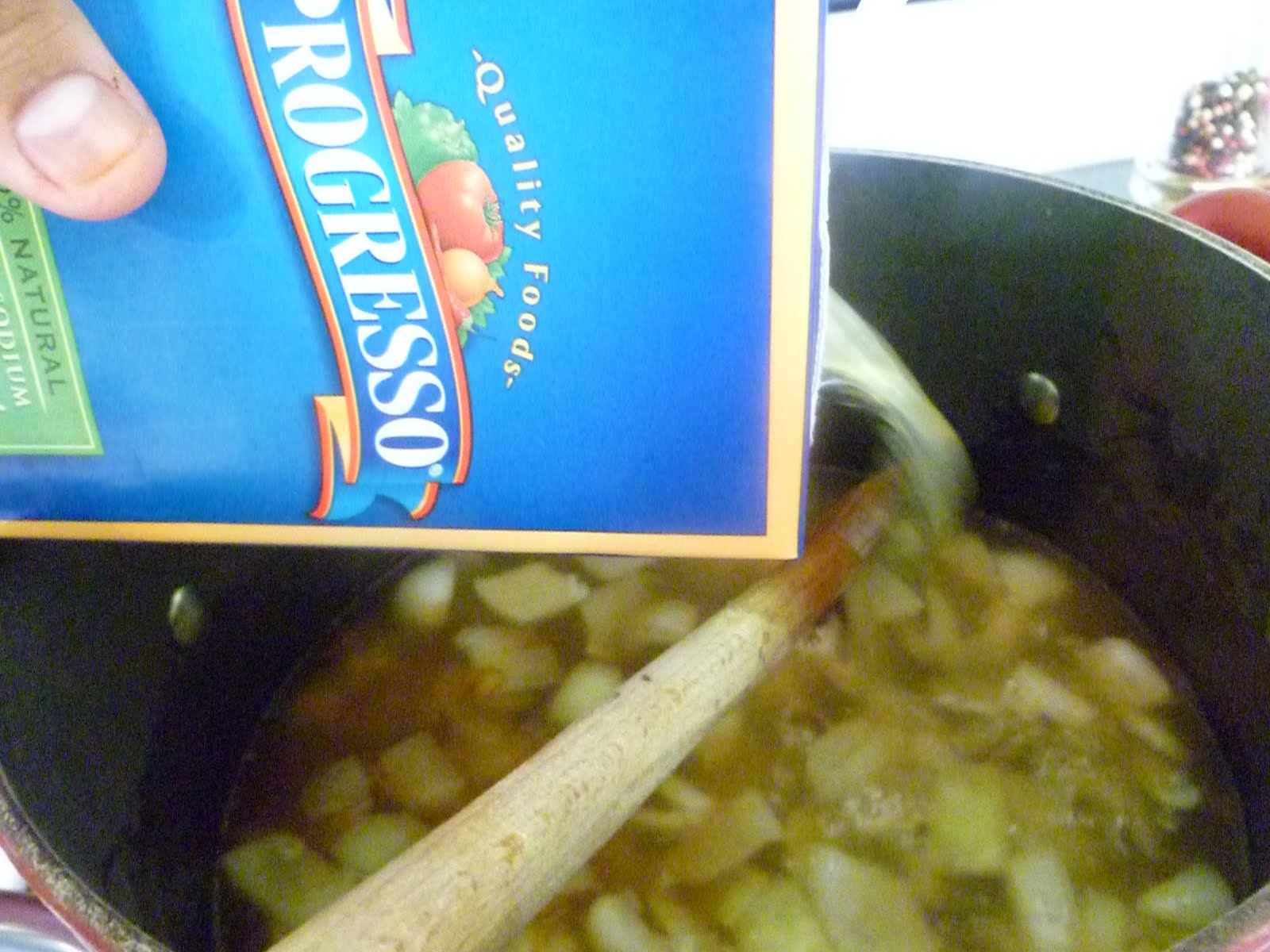
By the time your veggies are chopped, your onions should be softened. You can pour in your chicken (or vegetable) broth, and pile in your vegetables.
Okay, in an idea world, I would have put the vegetables in and THEN poured in the broth. But I wasn't quite done chopping (taking pictures while cooking can mess up your timing, haha) so I reversed the steps. And was extra careful not to burn myself with the hot broth.
Chuck in a bay leaf.
Now sit back and read a book while the stove does the work for you.
Once the vegetables are boiled and soft, it's time to blend everything together.
Be sure to remove the bay leaf first!

This is an immersion blender. It's my favorite tool to use for pureeing soup. It's fairly easy to clean and its long, thin shape makes it easy to store in my pantry. And it's so much safer (and less messy) than using a regular blender.
One of these days I'm going to buy myself a fancier blender. My mom has one with a detachable stick, so you can clean the blender blade in the dishwasher. Mine isn't detachable so I have to be careful when I clean it--no water in the electric base! But it gets the job done.
And if you think you need to spend the big $$, think again. I'm pretty sure this was a $15 purchase at TJ Maxx.
Be careful when you use your blender. You need to keep the part with the blade under the surface of the soup at all times, or you'll get hot soup splattered on you.
Also, with a thick soup like this, take the pot off the heat while you blend. Otherwise the heat sends up large bubbles that pop--again, sending hot soup onto your face. Ever seen a video of hot lava bubbling? Yeah. It's kind of like that.
The immersion blender is an amazing tool. It turns this ...
... into this. Isn't that about the prettiest color of soup you could imagine?
To make it a little rich and creamy, I like to splash in some half and half.
A healthier option would have been yogurt or silken tofu. Or to add nothing. But, if you've been around the blog long enough, you'll notice that I like to add half and half to things. Maybe it's an addiction.
Now comes the curry powder. I added a big tablespoonful.
I also tried not to breathe in too heavily while taking this picture. I can't imagine curry powder in the nose feels very good.
Finally, I shake in some cayanne pepper, for heat. It adds a little spice to the tail end of every bite.
Recipe: Curried Butternut Squash Soup
2 tbsp. butter
1 medium onion, roughly chopped
1 2-3 lb. butternut squash, peeled and roughly chopped
2 potatoes, peeled and roughly chopped
3 carrots, peeled and roughly chopped
1 granny smith apple, peeled, cored, and roughly chopped
1 bay leaf
47 oz. (one box plus one can) chicken stock (or enough to cover all the vegetables)
salt and pepper
1 tbsp. curry powder
pinch cayenne pepper
1/2 c. half and half
Garnishes of your choice
Saute onions in butter until softened. Add chopped vegetables, bay leaf, and chicken stock. Salt and pepper to taste.
Let everything simmer gently together until vegetables are softened. Blend everything together until completely pureed.
Add curry powder, cayenne pepper, and half and half. Stir to combine.
Garnish and serve.
Here is today's ingredient lineup. Pretty simple, easy ingredients, don't you think?
The first thing you'll want to do is start sauteing the onion in some butter.
While your butter is melting and your onions are softening, get to work peeling your vegetables and apple.
As this is a squash soup, it's important that you do two things--one, be sure to buy a butternut squash! They have a creamy texture that is perfect for a pureed soup. Do not make a mistake and pick up, say, a spaghetti squash.
Two, be sure to look over all the squash at the store. Buy a butternut squash that is heavy for its size. A light squash is full of seeds that you'll just be throwing away.
I'll tell you one other thing. Peeling a squash can be incredibly tedious and frustrating. They're heavy, the flesh gets slippery once the peel is removed, and they're funny-shaped. Here is where a nice, sharp vegetable peeler will come in handy.
I went through a period where it seemed gnomes were coming into the kitchen and stealing my kitchen tools--I lost a new knife before even using it once, followed by a cutting board, and then two vegetable peelers. I still haven't found the knife or the cutting boards, but the kitchen gnomes must not have liked my peelers. The peelers eventually made their way out of the woodwork. Today I am the proud owner of five different vegetable peelers. Just call me Edward Peelerhands.
The vegetable peeler I used today (and the one I like to use on tougher vegetables, like squash or sweet potatoes, is the Oxo Good Grips peeler. It makes easy work of peeling the hard to peel.
Once your vegetables are naked, it's time to cut them up. I do a chunky cut, since everything will be going into a pot and boiled. There's no need for pretty, tiny dices. As long as everything is roughly the same size, you'll be fine.
Here's how I core an apple. I like to cut it into quarters and then lay it on a flat side. I cut in at an angle.
I end up with a plank of apple that contains all the seeds but not much of the apple itself.
By the time your veggies are chopped, your onions should be softened. You can pour in your chicken (or vegetable) broth, and pile in your vegetables.
Okay, in an idea world, I would have put the vegetables in and THEN poured in the broth. But I wasn't quite done chopping (taking pictures while cooking can mess up your timing, haha) so I reversed the steps. And was extra careful not to burn myself with the hot broth.
Chuck in a bay leaf.
Now sit back and read a book while the stove does the work for you.
Once the vegetables are boiled and soft, it's time to blend everything together.
Be sure to remove the bay leaf first!
This is an immersion blender. It's my favorite tool to use for pureeing soup. It's fairly easy to clean and its long, thin shape makes it easy to store in my pantry. And it's so much safer (and less messy) than using a regular blender.
One of these days I'm going to buy myself a fancier blender. My mom has one with a detachable stick, so you can clean the blender blade in the dishwasher. Mine isn't detachable so I have to be careful when I clean it--no water in the electric base! But it gets the job done.
And if you think you need to spend the big $$, think again. I'm pretty sure this was a $15 purchase at TJ Maxx.
Be careful when you use your blender. You need to keep the part with the blade under the surface of the soup at all times, or you'll get hot soup splattered on you.
Also, with a thick soup like this, take the pot off the heat while you blend. Otherwise the heat sends up large bubbles that pop--again, sending hot soup onto your face. Ever seen a video of hot lava bubbling? Yeah. It's kind of like that.
The immersion blender is an amazing tool. It turns this ...
... into this. Isn't that about the prettiest color of soup you could imagine?
To make it a little rich and creamy, I like to splash in some half and half.
A healthier option would have been yogurt or silken tofu. Or to add nothing. But, if you've been around the blog long enough, you'll notice that I like to add half and half to things. Maybe it's an addiction.
Now comes the curry powder. I added a big tablespoonful.
I also tried not to breathe in too heavily while taking this picture. I can't imagine curry powder in the nose feels very good.
Finally, I shake in some cayanne pepper, for heat. It adds a little spice to the tail end of every bite.
I like to top my soup with a spoonful of sour cream, some crispy bacon, and a sprinkling of chives. But don't limit yourself to my choices. Some other topping suggestions include Parmesan or cheddar cheese, diced apples, croutons, ham or proscuitto, various herbs (fried sage leaves or fried garlic chips would be amazing), sunflower or pumpkin seeds, and creme fraiche or heavy cream (maybe a curry-spiced whipped cream!). Take this recipe and decorate it any way you see fit.
Recipe: Curried Butternut Squash Soup
2 tbsp. butter
1 medium onion, roughly chopped
1 2-3 lb. butternut squash, peeled and roughly chopped
2 potatoes, peeled and roughly chopped
3 carrots, peeled and roughly chopped
1 granny smith apple, peeled, cored, and roughly chopped
1 bay leaf
47 oz. (one box plus one can) chicken stock (or enough to cover all the vegetables)
salt and pepper
1 tbsp. curry powder
pinch cayenne pepper
1/2 c. half and half
Garnishes of your choice
Saute onions in butter until softened. Add chopped vegetables, bay leaf, and chicken stock. Salt and pepper to taste.
Let everything simmer gently together until vegetables are softened. Blend everything together until completely pureed.
Add curry powder, cayenne pepper, and half and half. Stir to combine.
Garnish and serve.
Saturday, July 31, 2010
Lamb Curry
The first time I had curry was in high school. One of my friends wanted to meet for lunch, and, being a vegetarian as well as a self-professed food snob, he didn't want to meet just anywhere. He suggested one of the Indian restaurants in town. I, not wanting to seem the lame friend, agreed, and showed up, somewhat hesitant but willing to give it a try. I figured if I didn't like it, I could just eat the rice.
There was no need to worry.
I piled my plate with food with exotic names--chicken makhani, rogan josh, pakora. Underneath lay my safety of basmati rice (flavored with saffron) and on top was a small mountain of naan. In the end, both were used to soak up the gravy left behind.
| Everything you'll need for the best curry you'll ever eat outside India |
Since then, I try to get a curry fix whenever I can. Unfortunately the nearest Indian restaurant is two hours away. So I started making my own. It's become a staple in our house, and I make it at least once a month. The recipe is enough for our family to eat for at least a couple of meals. It can be made on the stove, in the oven, or in a crock pot. It can be made with pork, chicken, lamb, or (even though it seems kind of wrong to me!), beef. You could even do it with chickpeas or potatoes if you wanted to go the vegetarian route--or if you had too many guests and not enough meat, you could add potatoes along with the meat.
It's become a comfort food, in the same category as roasted chicken or beef stew. And, although it might seem like a complex recipe, once you've made it a couple times and have all the ingredients at hand it gets really easy.
The first thing you'll want to do is get your spices ready. You'll need a stick of cinnamon, cloves, peppercorns, bay leaves, and a cardamom pod.
In a seperate bowl, get your secondary spices ready (these will go in later, but it's a lot easier to measure stuff out before you've got it all going on the stove. That way there's no panic about things burning!) For your secondary spices, you'll want turmeric, coriander, cayenne, and garam masala. I also like to add in some premade curry powder--I don't know what it is but there's something familiar and comforting about it.
Garam masala is actually a blend of spices. It usually has ground white and/or black pepper, cloves, cumin, coriander, and other flavorful spices. The flavor of your curry will be dependant on what spices are in your particular blend.
I know some of the other spices seem unfamiliar, but whole coriander (which is the seed of the cilantro plant), bay leaves, and cloves came with my spice rack. I grind the coriander myself, either in a mortar and pestle or in a coffee grinder. Turmeric should be easy to find anywhere. Cardamom pods may be harder to find--I buy mine at specialty food stores or a food co-op. If you really can't find them anywhere, I have substituted ground cardamom, which can be found at most grocery stores. If I use ground, then I add it with the rest of the ground spices, not the whole ones.
Next you'll want to chop your onion. Chopping onions is really easy and something everyone should know how to do. First, you need to peel the onion and chop off the stem end (leave the root intact or your onion will fall apart.) Cut the onion in half. Then cut the onion toward the root.
Turn the onion 90 degrees and cut again. This will make nice, tidy dices of onion.
See? How easy was that?
Here's what everything will look like when it's all prepped and ready.
The next step will require a large pot. Measure your oil and add your first spices (cinnamon, etc.). Heat everything over medium heat.
While your spices are toasting, you'll want to mince a large garlic clove and a knob of ginger. Be sure to mince them up really, really finely. Biting into a piece of ginger is not the best experience you'll have in your life.
Today when I was at the store I found this jar of ginger and garlic paste. I'm going to give it a try today, instead of doing more chopping--anything to save a couple minutes!
At this point, your spices should be getting nice and toasty. Don't stand too close (for example, with your face over the pot, inhaling), because sometimes the spices can pop.
When the bay leaves start to sizzle and the cinnamon stick starts to uncurl, fish the spices out and wrap them up in a piece of cheesecloth or a metal strainer. You don't have to do this, but then there's the risk of biting into a clove or a whole peppercorn later. They're pretty distinctive-looking so it's not a huge problem, but for me it's just a "because I can" thing. And because we have a toddler who might not know to eat around the whole cloves.
Anyway, once you've collected all the spices if you're going to, seal whatever you're using to keep them in and toss the spice package back into the pot.
Add your onion to the pot. Saute them until they turn a delicious golden brown. Keep watch over them so nothing burns. It's easy to walk away and forget about them, and that's something you definitely don't want to do.
I know. I've done it before. Nothing is as disheartening as watching part of your dinner go into the trash, even if it is just onions.
Once the onions are caramelized, it's time for the next step.
Add in the garlic and ginger. Also add in some cubed lamb. You can use any cut of lamb you like--this is leg. You'll want to use something tougher though (don't waste chops on this!), since it's going to be braising for a while. Season everything with salt and pepper and cook for another 20 minutes.
After the lamb has cooked a bit, add in your ground of spices (turmeric, coriander, etc.)
Add 2 tablespoons of water to keep your spices from sticking and burning, and cook until everything is combined, about 5 minutes.
Add a can of tomatoes. I'm fond of these fire-roasted tomatoes but really any kind of diced tomato you have on hand will do. Cook for another few minutes, and then lower the heat to medium-low. Add 2 cups of water.
Add a can of coconut milk. I love coconut milk. It smells so yummy and tropical.
Coconut milk is made from the meat of the coconut. The coconut meat is squeezed through cheesecloth or a sieve, and what comes out is canned.
As you can see here, the coconut milk looks kind of watery. Sometimes the coconut mix can solidify. The lighter, more watery substance floats to the top, leaving ...
... a solid substance on the bottom of the can.
You can avoid this by shaking the can vigorously before opening, but in this case it's all going in the pot so it doesn't really matter if it's a solid or a liquid.
| It's all coming together... |
Cover the pot and cook the curry until the meat is tender, at least 2 hours. Your house will fill up with a spicy, sweet, meaty smell that will make you hungry long before the curry is ready.
I've done this recipe in a crock pot before; it worked fine but it got a little dry. If you go the crock pot route, you'll still want to do everything up until the meat step on the stove, and then pour everything into your crock pot. Add an extra cup or so of water, too. Nothing smells as bad as something burning in a crock pot. If you're around while it's cooking, try to stir it every once in a while.
If you finish this off in an oven, do the same as if you were making it in a crock pot but set the oven temperature to 300F and don't add the extra water.
Either way, this curry is amazing when served with basmati rice. Sometimes I make it with homemade naan (recipe tomorrow!) Other times, if I'm strapped for time, I'll use storebought pita bread, either grilled or drizzled in olive oil and wrapped in foil and warmed in the oven. The bread adds a different texture to your meal, and is a great tool to sop up the extra gravy. Make this lamb curry tonight, you will not be sorry.
Recipe: Lamb Curry
1 1/2 pounds lamb, cubed
1/4 c. vegetable oil
2 bay leaves
1 cardamom pod
1 2" piece of cinnamon stick
4 whole cloves
10 peppercorns
1 1/2 c. chopped onion
1 tbsp. minced ginger (or ginger paste)
2 tsp. minced garlic
*Note: I have also used ginger and garlic paste. In this case, I used around 3 tbsp. instead of the minced ginger and garlic that the recipe calls for.
1/2 tsp. turmeric
1/2 tsp. curry powder
2 tsp. coriander
1 tsp. cayenne pepper
1 1/2 tsp. garam masala
1 16-oz can diced tomatoes
1 16-oz can coconut milk
Heat oil in a large pot; add bay leaf, cardamom pod, cinnamon stick, peppercorns, and whole cloves.
When bay leaves start to sizzle and cinnamon stick begins to uncurl, add onions and saute until golden brown, about 12-15 minutes.
Add minced ginger and garlic. Season with salt and pepper and cook for 20 minutes.
Add ground spice mix. Stir for 5 minutes and add 2 tbsp. of water to keep from burning.
Add tomatoes; cook 5 minutes. Lower heat to medium-low. Add 2 c. water.
Add coconut milk and stir to incorporate.
Cook until meat is tender, 2-3 hours. Serve over basmati rice and with flatbread. Sprinkle with chopped cilantro if desired.
Subscribe to:
Posts (Atom)